
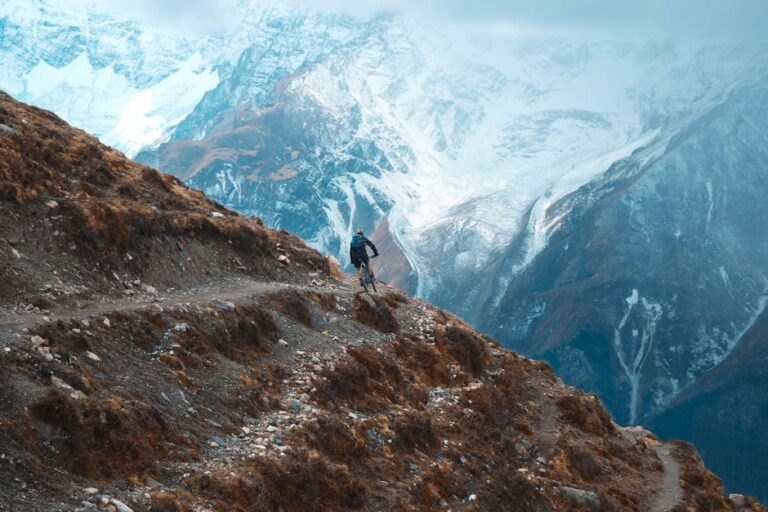
Key takeaways
- Steel frames with 50mm tire clearance and mechanical disc brakes form the foundation of reliable adventure bikes across varied terrain.
- A 1x drivetrain with 11–50 cassette balances climbing power and maintenance simplicity for unpaved riding without daily upkeep.
- Weight distribution (60% rear rack, 20% framebag, 20% back) keeps handling stable when loaded for multi-day tours and descents.
- Mechanical disc brakes beat hydraulic on expeditions because they work when muddy and need only basic tools to adjust in the field.
Adventure cycling requires a different frame of mind than road racing or casual Sunday rides. You need gear that handles unpaved surfaces, works in mud and water, carries gear, and won’t fail 30 miles from the trailhead. What actually matters comes down to a few core systems: the frame, tires, brakes, drivetrain, and how you carry your load.
Frame and Tire Clearance
The frame is your foundation. Adventure cycling demands at least 700c wheels with tire clearance for 45mm+ tires—ideally 50mm or wider. Steel frames are industry standard for adventure bikes because they absorb road buzz, handle high-load touring, and are easily repaired in remote areas. The Trek 920 and similar steel adventure platforms run approximately $1,200–1,500 for the frameset and are built to handle loaded touring with 50mm tire clearance.
Aluminum frames are lighter and cheaper—expect $600–1,000 for frameset only—but they transmit more vibration over rough ground and are less forgiving under load. Carbon frames offer weight savings but can crack on rocky descents, and repair options are limited outside major cities. Steel wins for pure adventure duty.
Tire Selection and Rolling Resistance
Tire choice matters more than frame material for how your bike actually rides. Schwalbe G-One Allround in 45–50mm size ($45–65 per tire) sits at the sweet spot: fast enough on gravel, predictable on rocks, and robust enough for 2,000+ miles. WTB Venture and Maxxis Rambler are comparable options with similar price points and durability metrics.
Tread pattern determines behavior. Slick or near-slick tires roll fast on gravel but slide on wet clay and loose rock. Knobby tires grip better in technical terrain but slow you down on hardpack. A 50/50 tread—small knobs with tight spacing—gives you the most versatility across different surfaces without picking a lane.
Wheel Size and Acceleration
29-inch wheels (700c) are standard for adult adventure bikes and roll faster over obstacles. 27.5-inch wheels accelerate quicker and fit larger tires in the same space, useful if you need 60mm+ clearance. Most adventure cyclists stick with 29-inch because tire options are deeper and geometry is more stable when loaded.
Braking Systems
Disc brakes are mandatory for adventure cycling. Rim brakes fail in mud, overheat on long descents, and are impossible to modulate when wet. Mechanical disc brakes (cable-actuated, like Shimano XT) are preferred over hydraulic because they work when muddy and require only basic tools to adjust. Hydraulic brakes stop better but need a bleed kit and syringe—not practical 20 miles into a backcountry ride.
Disc Size and Stopping Power
180mm front and 160mm rear is standard. Larger rotors (203mm) stop harder but are heavier and more prone to warping under load. Smaller rotors (160mm) are sufficient for riders under 200 pounds on non-technical terrain. If you’re touring with 40+ pounds of gear down steep descents, move to 203mm front; otherwise, standard sizing keeps weight down.
Maintenance in the Field
Mechanical disc brakes need only an Allen key to adjust cable tension and a flathead screwdriver to center the pads. Hydraulic brakes require a bleed kit ($30–50), mineral oil, and a sealed system to function. On a month-long expedition where you can’t visit a bike shop, mechanical brakes are the only practical choice. If your ride is day trips only, hydraulic stopping power might justify the maintenance burden.
Drivetrain: Gearing for Climbing
A 1x system (single chainring up front, cassette in back) simplifies maintenance and eliminates chain drops on rough terrain. Pair a 30-tooth or 32-tooth ring up front with an 11–50 tooth cassette to climb steep grades while maintaining efficiency on flats. SRAM NX or Shimano Deore offer reliable 12-speed 1x drivetrains at $400–700 for components.
Rohloff internal hub gearing ($2,000–3,500 fully built) eliminates visible drivetrain components, never requires cleaning, and shifts under load. It’s overkill for weekend rides but invaluable for expeditions in remote regions where a broken derailleur means walking out. Most adventure cyclists skip internal gears unless they’re going on extended expeditions or live in muddy climates year-round.
Cassette Ratio and Climbing Angle
An 11–50 tooth range gives you a 4.5:1 ratio—enough to climb 15% grades even when loaded. Drop to 11–46 if you ride mostly terrain under 10% gradient; jump to 11–52 if you regularly encounter sustained 12%+ climbs. Each step up in the big cog costs roughly 50 grams and adds $20–30.
Saddle and Handlebar Fit
An uncomfortable saddle ruins 100-mile days. The Specialized Power or WTB Volt are solid off-road choices at $120–180; both have wide platforms, cut-out zones to relieve pressure, and enough padding for loaded touring. Test multiple saddles because pelvic anatomy varies—what works for one cyclist may cause numbness for another. Rent or borrow before buying.
Handlebar Reach and Drop
Flared drop bars widen as they drop, giving you more hand positions and stability on descents. Flat or slightly flared bars reduce hand fatigue on rough terrain. Drop bars require bar-end shifters (friction shifters from SRAM or Shimano) instead of brifters, adding simplicity and repairability. If you’ve never used drop bars on gravel, start with flats and add them later if you feel unstable on high-speed descents.
Baggage: Carrying Capacity Without Sacrificing Handling
Framebags distribute weight low and central, keeping the bike’s center of gravity stable. A 6-liter framebag holds 10–12 pounds and is standard for day tours. Racks mounted over the rear wheel (Old Man Mountain or Tubus) hold 25–50 pound loads and are mandatory for multi-day trips. Panniers hanging from racks sit lower than backpacks, so your center of gravity stays stable on technical descents.
Weight Distribution Rules
Keep 60% of your load on the rear rack, 20% in a front rack or framebag, and no more than 20% on your back. Putting too much on the front wheel makes steering twitchy; loading the back too heavily destabilizes climbing. A loaded adventure bike with 60 pounds total will climb and descend predictably only if the weight is balanced this way.
Navigation and Safety Electronics
A GPS computer (Garmin Edge or Wahoo ELEMNT) logs your route and helps with navigation on unmarked trails. Budget $300–500 for a basic computer; avoid relying solely on your phone because batteries fail when cold or muddy. Carry printed maps as backup—they never fail.
Lights matter on dawn or dusk rides. Pair a 400-lumen front light with a rear blinker, both rechargeable. If you’re riding after dark regularly, invest in 800+ lumens; budget $80–150 for a decent set. Dynamo hubs ($300–500 wheel cost) are valuable on expeditions because they generate light from wheel rotation and eliminate battery worry on three-week trips.
The Maintenance Kit You’ll Actually Use
Carry a multi-tool, chain breaker, spare chain link, two tire levers, a hand pump, and one spare tube. A patch kit is backup only—most flats happen because the tube is punctured beyond repair. Include a 15mm wrench for disc rotor bolts and a 5mm Allen key for common bolts. Total weight is under three pounds. A full toolbox attracts weight you’ll never touch; a bare minimum stops you from walking out.
Frequently Asked Questions
Do I need a full suspension adventure bike?
No. Adventure cycling works on hardtails. Full suspension adds weight, complexity, and cost. Most expedition cyclists use rigid or hardtail frames because they're lighter, cheaper, and easier to repair in remote areas.
Can I use a road bike for adventure cycling?
A road bike cannot handle gravel comfortably. Road frames lack tire clearance for 45mm+ tires, rim brakes fail in mud, and geometry is designed for speed on pavement, not stability under load. Switch to a gravel or adventure bike.
What's the minimum gear needed to start adventure cycling?
A steel or aluminum gravel frame with 700c wheels, mechanical disc brakes, a 1x drivetrain, and 45–50mm tires. Add a multi-tool, spare tube, and hand pump. You can spend $1,500–2,500 on a solid used or entry-level new bike and start immediately.
